由于環(huán)境污染對書畫的損害非常大���,尤其在城市里���,汽車尾氣和工業(yè)污染使空氣中酸堿的含量比較高��,有害氣體和細(xì)小塵埃懸浮于空中�,日久天長沉積在畫面上���,就會侵蝕畫面��。一般說���,一月除塵一次為佳,根據(jù)季節(jié)變化可適當(dāng)延長或縮短���。
Because environmental pollution is very harmful to calligraphy and painting, especially in cities, automobile exhaust and industrial pollution make the content of acid and alkali in the air relatively high, harmful gases and fine dust suspended in the air, deposited on the screen over time, will erode the screen. Generally speaking, it is better to remove dust once a month, and it can be appropriately extended or shortened according to seasonal changes.
除塵方法:可用電吹風(fēng)的自然風(fēng)��,將出風(fēng)口與畫面成30度角���,保持10厘米15厘米的距離,從右向左清掃����;或?qū)⑽鼔m器開到低風(fēng)���,配以軟毛刷清掃,在清掃的過程中用吸塵器將塵埃吸走(使用此法要特別注意吸嘴與畫面的距離以及吸力的大小��,以免誤傷作品)�;也可用雞毛撣輕輕清掃畫面。切不可用抹布一類物品擦拭畫面�����,因為在擦拭的過程中�,細(xì)小灰塵會進(jìn)入紙張的紋里,造成更大的損害�����。
Dust removal method: use the natural wind of the electric hair dryer to make the air outlet and the picture at a 30 degree angle, keep a distance of 10 cm to 15 cm, and clean from right to left; or turn the vacuum cleaner to low wind, with a soft brush to clean, and use the vacuum cleaner to suck away the dust in the cleaning process (pay special attention to the distance between the nozzle and the picture and the size of the suction, so as not to hurt the work); or Clean the picture with a feather duster. Do not use cloth to wipe the picture, because in the process of wiping, fine dust will enter the grain of the paper, causing greater damage.
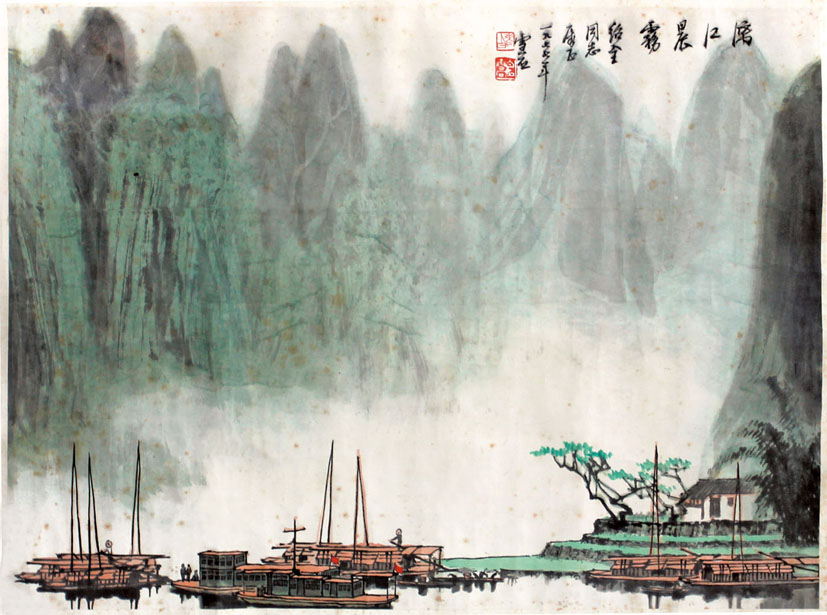
掛展一年以2次為宜���,一次一到兩個月�����。其余時間應(yīng)該收藏���。藏置環(huán)境要嚴(yán)格要求����。是防蟲���、防潮、防火����,其次是控制和調(diào)節(jié)存放環(huán)境的溫、濕度�,切忌高溫、高濕���、重壓�。蠹魚(也稱衣魚���、紙魚)是無翅昆蟲��,一般蛀食書畫表面����,特別危害糨糊粘貼處�����。煙草甲的幼蟲對書畫危害很大,喜歡在書畫中打洞���,而自身藏于洞內(nèi)���。一般書畫防蟲多用驅(qū)避劑,常用的有衛(wèi)生球�、樟腦丸、對二氯化苯����,這些物品都是白色固體,易于揮發(fā)�,其中對二氯化苯殺蟲能力較強。存放環(huán)境要求書畫箱柜的密封性要好�,使保存環(huán)境相對穩(wěn)定。
It is better to hold exhibitions twice a year, one to two months at a time. The rest of the time should be collected. The storage environment should be strict. The first is to prevent insects, moisture and fire. The second is to control and adjust the temperature and humidity of the storage environment. Avoid high temperature, high humidity and heavy pressure. Bark beetles (also known as clothed fish and paper fish) are wingless insects, which generally eat the surface of calligraphy and painting, especially the paste paste. Tobacco beetle larvae do great harm to painting and calligraphy. They like to make holes in painting and calligraphy, but hide themselves in the holes. Generally speaking, repellents are commonly used in painting and calligraphy, such as sanitary balls, camphor balls, and p-dichlorobenzene. These articles are white solid and easy to volatilize, among which p-dichlorobenzene has strong insecticidal ability. The storage environment requires that the seal of the painting and calligraphy cabinet should be good, so that the storage environment is relatively stable.
木箱以樟木為佳����,因樟木本身就可防蛀,且密封性好���。無論用哪種箱柜���,都要把字畫懸空放置�,下面留出空間放置干燥劑�����、防蟲劑�����。這些試劑都應(yīng)當(dāng)用布或透氣性較好的紙包起來���,不可直接接觸書畫。若要移動或運輸字畫�����,千萬不能直接移動或搬運箱柜�����,而應(yīng)打開箱柜����,取出藥品���,并將字畫固定好,避免字畫在箱內(nèi)相互碰撞��。根據(jù)大量的實驗證明�,字畫適宜的保存溫度為14℃18℃之間,合適的相對濕度為50%60%�����,這樣的條件��,不利于微生物��、霉菌的生長和繁殖���??刂茲穸?����,主要用干燥劑變色硅膠或無水氯化鈣�。控制溫度,則可用空調(diào)調(diào)節(jié)室內(nèi)溫度�。
Camphor is the best wood box, because camphor itself can be mothproof, and good sealing. No matter what kind of cabinet is used, the calligraphy and painting should be placed in the air, and the space below should be reserved for desiccant and insect repellent. These reagents should be wrapped in cloth or paper with good air permeability, and should not be in direct contact with calligraphy and painting. If you want to move or transport calligraphy and paintings, you must not directly move or carry the cabinet. Instead, you should open the cabinet, take out the medicine, and fix the calligraphy and paintings well to avoid the collision of calligraphy and paintings in the box. According to a large number of experiments, the suitable storage temperature of calligraphy and painting is between 14 ℃ and 18 ℃, and the suitable relative humidity is 50% to 60%. Such conditions are not conducive to the growth and reproduction of microorganisms and molds. Control humidity, mainly with desiccant silica gel or anhydrous calcium chloride. If the temperature is controlled, the indoor temperature can be adjusted by air conditioning.


 發(fā)布時間:2021-04-15
  作者:大雅堂美術(shù)館
  文章來源:http://www.tz998.com/
  瀏覽量:0
瀏覽量:0






 首頁
首頁 產(chǎn)品
 電話
電話 置頂
置頂